Arizona National Park Units
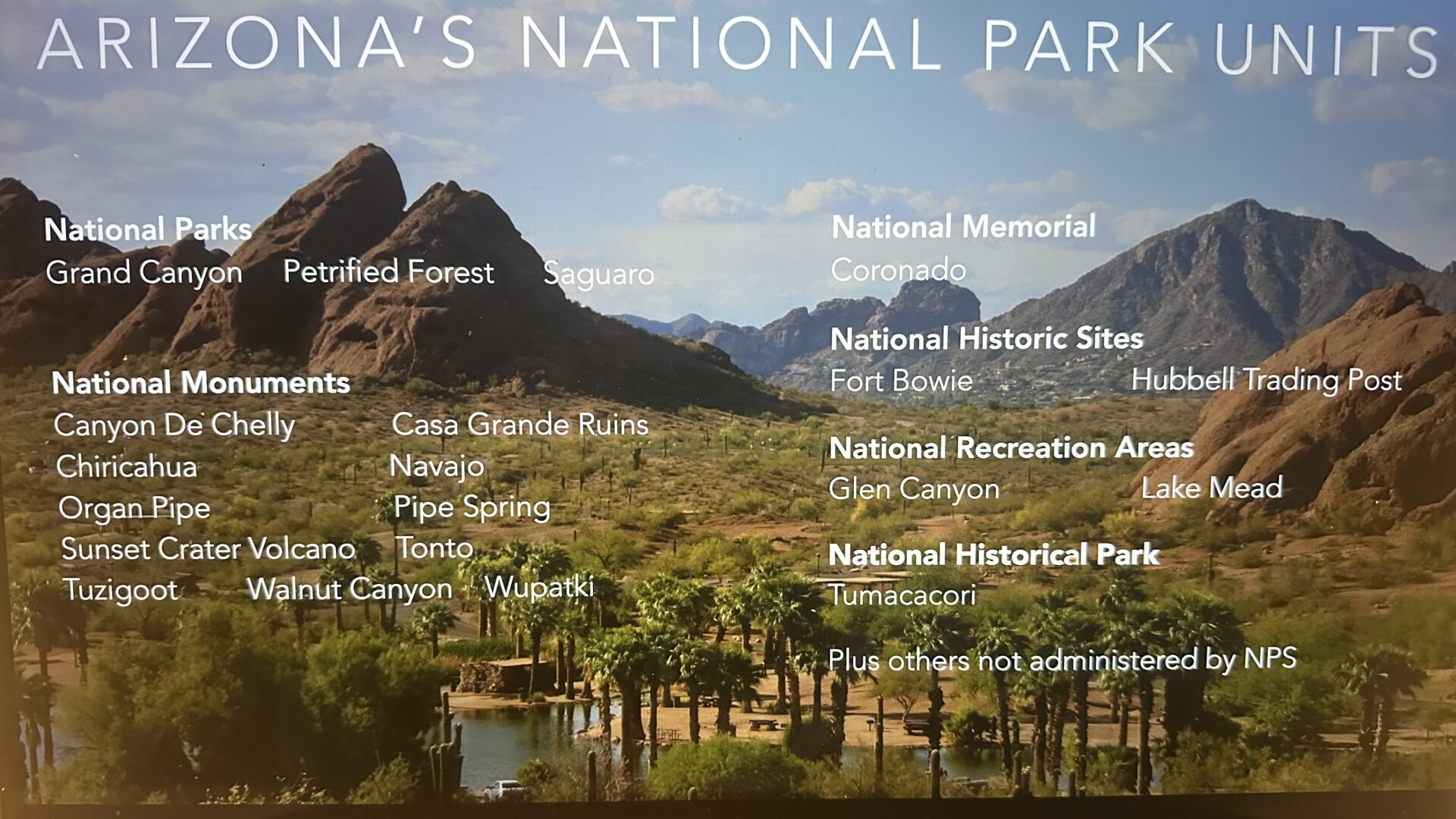
We are quite often invited to local libraries to talk about our quest to visit all of the National Park Units. We always include a discussion of the various units here in our home state of Arizona. While most people are familiar with the Grand Canyon, many are not aware that there are 21 national park units in Arizona.
We always start with a bit of trivia. Can you identify the park in this photo?
This is Papago Park in Phoenix, but at one time it was a National Monument – designated as the Papago-Saguaro National Monument in January 1914 by President Woodrow Willson, protecting over 2,000 acres of Sonoran desert as well as the unique “Hole in the Rock”. But in 1930, the monument was “de-listed” and the park was returned to state and local control. It wasn’t until 1959 that the City of Phoenix acquired much of the land and developed it as parkland that includes the Phoenix Zoo and the Desert Botanical Garden.
National Parks in Arizona
There are three national parks in Arizona: Grand Canyon, Petrified Forest and Saguaro National Park
- Grand Canyon National Park was established in 1919 and encompasses over 1.2 million acres in northern Arizona. It is the most visited national park in the US. Most popular to visit is the south rim, with all of the expected tourist amenities. Although a bit more out of the way, we always recommend taking the time to visit the north rim. The drive out to Point Imperial takes you to amazing viewpoints and there are some lovely hikes. Check out our other blogs about the Grand Canyon for ideas.
- Petrified Forest became a National Park in 1962, but actually was set aside as a National Monument in 1906 to protect the fossilized wood from theft. It spans 221,000 acres in the northeastern corner of Arizona. There is a 28 mile scenic drive through the park with lots of interesting stops along the way. See our blog for some photos.
- Saguaro was also initially established as a National Monument, back in 1933. It did not become a National Park until 1994. Most people will only visit the west side of the park, where the visitor center and main trails are located, but we always recommend checking out the east side as well. Nestled up against the mountain, this section includes more wilderness and offers longer hikes. There is also an 8 mile scenic drive that is perfect for runners and cyclists!
National Monuments in Arizona
There are 11 national monuments in Arizona, all of which offer insights into the rich history of the state.
- Chiricahua National Monument in southern Arizona is one of our favorite places in the state. It is known as the “wonderland of rocks” and that is exactly what it is – a wonderland. Congress are currently considering a proposal to make this the 64th National Park and it certainly would be deserving.
- Organ Pipe National Monument on the US / Mexico border is known for the organ pipe cacti, especially vibrant in the spring when they flower. But it is also the home to lots of history, including the remains of an old mine as well as prehistoric sites. Like Saguaro, Organ Pipe also has a west and east side. Most visitors go to the west, but the east offers a lovely scenic drive and nice hiking.
- Several National Monuments can be found in the Flagstaff area. Sunset Crater Volcano is the youngest volcano on the Colorado Plateau. Hike to the top of nearby O’Leary Peak and you can see out over the volcanic field. The eruption at Sunset Crater in 1085 AD could be felt by the Native American inhabitants of Walnut Canyon and Wupatki (both also national monuments). One of the most interesting things to see at Wupatki is the ball court. Don’t miss the map in the visitor center that shows all of the ball courts around the state. Seems that they had “traveling teams” just like we do today. You can see another ball court at Casa Grande Ruins, just south of Phoenix.
- Other national monuments focused on Native American history include Canyon de Chelly, Tonto (just outside Phoenix) and Tuzigoot. Another national monument that most people drive right past on their way to Monument Valley is Navajo National Monument. It has a couple of very well preserved dwellings and a lovely free campground.
- One of the more remote National Monuments is Pipe Spring, on the Arizona / Utah border, just east of Fredonia. What makes this worth a visit is the history; experiencing how the white settlers changed the lives of the Native Americans.
National Memorials in Arizona
- Coronado National Memorial on the Arizona / Mexico border represents a different part of Arizona’s history; when the Spanish sent expeditions to find gold. Today it is probably better known for being the start of the Arizona National Scenic Trail, which stretches 800 miles from Mexico to the Utah border. If you go, be sure to take a flashlight because there is an interesting cave just a short walk from the visitor center.
National Historic Sites in Arizona
- Fort Bowie National Historic Site provides another insight into Arizona’s history, the fight over water. Fort Bowie was established to protect the water in Apache Springs as well as access to the Apache Pass. Unlike most other National Park Units, the only way to get to this one is to park at the trailhead and walk (unless you have Handicap plates). But don’t fret – it’s a nice walk and there are lots of things to see along the way. Just don’t go in the summer! Combine this with a visit to the Chiricahua – its just down the road.
- Hubbell Trading Post in the very northeast of Arizona is another interesting look at our history. Its claim to fame is that it has been continuously operated as a trading post since 1878. If you go, be sure to check to see what ranger programs they may have. We missed the one they did on how Native Americans used plants to make dye, and it looked really interesting.
National Recreation Areas in Arizona
Arizona also shares two huge National Recreation areas with our neighbors – Utah and Nevada.
- Glen Canyon National Recreation Area includes Lake Powell and the Glen Canyon Dam. While much of the area lies within Utah, several marinas and the dam are in Arizona. If you like to kayak, we highly recommend taking in the view of Glen Canyon Dam from the river below the dam. There are outfitters in Lees Ferry who will take you by speedboat up to the base of the dam, and then from there you can slowly kayak (float) back to your car.
- Lake Mead National Recreation is shared by Arizona and Nevada, and includes the famous Hoover Dam. Along with recreation on the lake, we recommend taking a bike ride or walk along the old rail trail. It is a 3.7 mile (one way) flat, gravel trail that goes through five 300-foot-long tunnels, originally used to move materials to the Hoover Dam construction site.
National Historic Parks in Arizona
- Tumacacori National Historic Parki south of Tucson is just one of many missions you can find in the southwest. This one is special because it links with the Juan Bautista de Anza trail, the way followed by settlers going from Mexico to San Francisco.
If you live in Arizona, or if you are visiting, we hope you will take some time to visit some or all of these National Park Units.